
Ray Dalio and Patricia Poppe are two famous names in the business world. One is a billionaire investor. The other is a top energy leader. People often search their names together, and this guide explains why.
In this article, you will learn who each person is, what they have achieved, and where their stories touch. You will also see which claims are confirmed and which ones are only rumors.
What Connects Ray Dalio and Patricia Poppe?
The main link is a business one, not a personal one. Dalio founded Bridgewater Associates, a huge investment firm. Poppe is the CEO of PG&E, a large utility company in California.
In the second quarter of 2026, Bridgewater raised its stake in PG&E by about 5.9 million shares, according to its latest SEC filing. This single fact is the reason many people now search both names together.
Still, a company owning shares in another company is normal. It does not mean the two leaders work together. Think of it like a person buying a stock. They do not become friends with the CEO.
Here is a quick view of the connection:
- Dalio built an investment firm.
- Poppe leads a utility company.
- The investment firm bought PG&E shares in 2026.
- No public record shows a direct partnership between the two people.
Who Is Ray Dalio?
Ray Dalio is an American investor, author, and billionaire. He is best known as the founder of Bridgewater Associates. His ideas about money and decision-making have reached millions of readers.
Ray Dalio and Bridgewater Associates
Dalio started Bridgewater in 1975. In the early days, he ran it from a small apartment in New York. Over time, it grew into one of the largest hedge funds in the world.
Bridgewater became famous for its unique style. It uses data, research, and strict rules to make investment choices. The firm is also known for its open and honest workplace culture.
The firm is known for several ideas:
- Risk parity: spreading risk evenly across different assets
- Pure Alpha: an active strategy that aims for high returns for each unit of risk
- All Weather: a portfolio built to perform in any economic season
Ray Dalio’s Journey From Investor to Founder
Dalio grew up in New York. As a boy, he worked as a golf caddie and bought his first stock at a young age. That early start sparked a lifelong interest in markets.
He later earned a degree from C.W. Post College and an MBA from Harvard Business School. He then worked in commodities and learned how global markets move.
From there, he took a big step. He began offering advice to clients, and that small business became Bridgewater. His path shows how a simple idea can grow with patience and hard work.
His Departure From Ownership
Dalio did not stay in charge forever. He resigned from his CEO role in 2017 and handed control of Bridgewater to a new generation of investors in 2022.
The final step came in 2025. Reuters reported that Bridgewater bought back the last ownership shares held by Dalio-related entities. So Dalio is no longer an owner of the firm he created.
This matters for our topic. Bridgewater’s 2026 trades are made by its current team. They are not personal choices made by Dalio.
Ray Dalio’s Major Achievements and Business Influence
Dalio’s biggest achievement is building Bridgewater into a global name. The firm manages money for large institutions around the world. His work changed how many investors think about risk.
He is also a bestselling author. His book Principles shares the rules he used in life and work. He later wrote about debt cycles and the changing world order.
His influence goes beyond finance. He has shared ideas on economics, history, and leadership. Many young professionals study his methods.
Here are his main areas of influence:
- Hedge fund strategy and risk management
- Workplace culture built on honest feedback
- Books and videos about money and decision-making
- Public commentary on the global economy
Who Is Patricia Poppe?
Patricia “Patti” Poppe is a senior American energy executive. She is the CEO of PG&E Corporation. She is known for her focus on safety, customers, and strong operations.
Patricia Poppe’s Early Career
Poppe did not start in the energy world. She began in the car industry. She worked at General Motors for 15 years in various roles before moving to the utility field.
That factory background shaped her style. She learned how to fix problems on the ground and how to improve processes step by step. These skills later helped her in the utility sector.
After the car industry, she moved to DTE Energy in Michigan. There she worked in power plant leadership. This was her first big step into energy.
Education Behind Poppe’s Career
Poppe has a strong technical and business education. She earned a bachelor’s and a master’s degree in industrial engineering from Purdue University, plus a management master’s from Stanford’s business school.
Industrial engineering is about making systems work better. It teaches people to cut waste, improve safety, and raise quality. These ideas fit utility work very well.
The Stanford degree added business and leadership skills. Together, the two schools gave her both the technical view and the management view. This mix is rare and useful.
Patricia Poppe’s Role at PG&E
Poppe joined PG&E in January 2021 after five years as President and CEO of CMS Energy and its main subsidiary, Consumers Energy. At CMS, she became known for focusing on customers and for lean operations.
PG&E said her safety work at CMS helped cut safety incidents by 70% since 2008. That record was a big reason the PG&E board picked her.
PG&E is one of the largest utilities in the United States. It serves millions of homes and businesses in California. Leading it is a huge and serious job.
Taking Charge After Bankruptcy
Poppe took over a company in a hard moment. PG&E had pleaded guilty to 84 counts of involuntary manslaughter for its role in the 2018 Camp Fire. The company was also recovering from bankruptcy.
Bloomberg noted that she would be PG&E’s third CEO in two years. Trust was low, and the public wanted real change.
Her task was clear. She had to make the grid safer, reduce wildfire risk, and rebuild public trust. This was one of the toughest jobs in American business.
Patricia Poppe’s Leadership at PG&E
At PG&E, Poppe has stressed safety and stability. The board agreed to a five-year contract extension that runs through 2030. She said the company needed steady leadership instead of constant change.
She also faces pressure. Electricity prices and outages have drawn public attention. A May 2026 public event covered affordability, outages, and a state bill nicknamed the “breakup bill.”
Despite the pressure, she remains the face of the company. She led PG&E’s second-quarter 2026 earnings call as CEO.
Did Ray Dalio and Patricia Poppe Work Together?
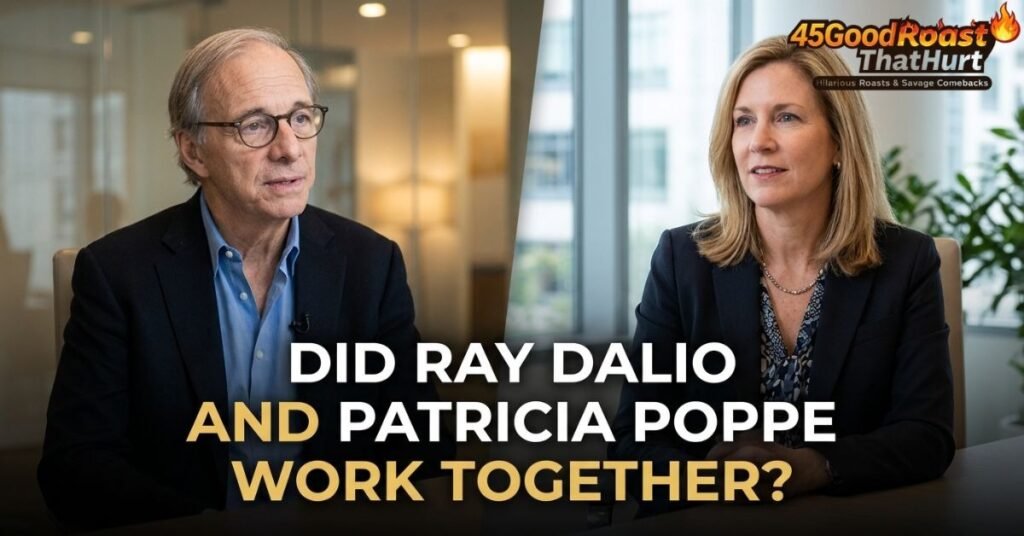
There is no public record that Dalio and Poppe have worked together. They come from different industries. One led an investment firm, and the other leads a utility company.
Dalio’s work is about markets, risk, and economic cycles. Poppe’s work is about power grids, safety, and customers. Their jobs rarely cross paths.
A shared stock holding is not teamwork. Investors can own shares in hundreds of companies. They do not manage those companies.
To stay accurate, remember these points:
- No verified joint project exists.
- No verified business partnership exists.
- No verified shared board role has been found.
- Any claim of direct teamwork needs solid proof.
Are Ray Dalio and Patricia Poppe Related?
No public source shows that they are family. They have different backgrounds, careers, and public profiles. Their last names are also different.
Search engines sometimes link two names that appear in the same news story. This can make people think there is a personal tie. In most cases, it is just a news pattern.
So the safest answer is simple. There is no evidence of a family link. Writers should not claim one without proof.
Did Ray Dalio Personally Invest in PG&E?
There is no verified public record that Dalio personally bought PG&E shares. The 2026 report is about Bridgewater Associates, which is a firm. It is not about Dalio as a person.
This difference is important. A firm’s 13F filing lists the holdings of that firm. It does not list the private accounts of its founder.
It matters even more because Dalio no longer owns Bridgewater. Reuters reported that he sold his last ownership shares in 2025. So the 2026 trade was made by the firm’s current team.
Keep these facts in mind:
- Bridgewater is the investor named in the filing.
- Dalio is the founder, but not the current owner.
- No personal PG&E purchase by Dalio has been confirmed.
The 2026 Bridgewater and PG&E Connection
This is the section that explains why 2026 matters. Bridgewater’s latest filing showed a big move into PG&E. It made headlines because the jump was very large.
The report said Bridgewater raised its PG&E stake by about 5.9 million shares, a jump of 24,078%. That huge percentage means the starting position was very small.
The same report said Bridgewater also bought into other energy names. It sold some big tech shares while adding oil and energy holdings. So PG&E was part of a wider shift.
Understanding the Difference Between Investment Firms and Utility Companies
An investment firm like Bridgewater buys and sells assets. Its goal is to grow money for clients. It does not run the businesses it invests in.
A utility company like PG&E delivers power and gas. It builds lines, fixes equipment, and serves customers. It is run by its own CEO and board.
Here is a simple comparison:
| Feature | Investment Firm (Bridgewater) | Utility (PG&E) |
| Main job | Manage client money | Deliver energy |
| Main goal | Investment returns | Safe, reliable service |
| Customers | Institutions and funds | Homes and businesses |
| Link to the other | Holds shares | Issues shares |
What Public Records Reveal About Their Business Connections
Public records show what each side did. SEC filings show Bridgewater’s holdings. Company releases and earnings calls show what PG&E and Poppe said and did.
None of these records show a meeting between Dalio and Poppe. They also do not show a contract or a joint plan. The only link is the stock holding.
A smart reader checks the source. A filing is strong proof of a holding. It is not proof of a personal relationship.
Why Do Their Names Appear Together?

Names often appear together online for simple reasons. News stories, stock reports, and search trends can mix them. In this case, the 2026 filing is the main trigger.
Another reason is curiosity. People see a famous investor and a famous CEO in one story. They then search both names to learn more.
The result is a lot of mixed content. Some of it is correct, and some is guesswork. That is why careful reading matters.
Media Coverage and Online Searches
When a big fund buys a big stock, finance websites report it fast. The headline often names the fund and its founder. This puts the founder’s name next to the company.
Then the company’s CEO is searched too. Readers want to know who runs the firm. That is how both names end up in the same search.
Search tools also suggest related names. If many people search two names together, the tool keeps pairing them. This can make a weak link look strong.
Separating Verified Facts From Speculation
A verified fact has a clear source. For example, an SEC filing or a major news report can confirm a stock purchase. These are strong sources.
Speculation has no clear source. Claims like “they are partners” or “they are family” fall here. Without proof, they should not be repeated.
Use this quick test:
- Does the claim name a real source?
- Is the source official or well known?
- Do other trusted sources agree?
- Is the claim about a firm or a person?
Ray Dalio and Patricia Poppe Career Comparison
Comparing their careers shows how different the two paths are. Dalio is an investor and founder. Poppe is an operator and executive. Both reached the top of their fields.
Dalio built a company from nothing. Poppe took over a large, troubled company. Each path needs strong skills, but the skills are not the same.
Dalio’s Career Timeline
Dalio’s timeline is built around Bridgewater. The key dates below come from public reports and his own writing.
| Year | Milestone |
| 1975 | Founds Bridgewater Associates |
| 2017 | Steps down as CEO |
| 2017 | Publishes Principles |
| 2022 | Hands control to a new generation |
| 2025 | Sells his remaining stake |
His story moves from founder to teacher. In later years, he spent more time writing and sharing ideas. His public voice grew even as his firm role shrank.
Poppe’s Career Timeline
Poppe’s timeline moves from factories to power plants to the CEO chair. Each job gave her new skills.
| Period | Milestone |
| Early career | About 15 years at General Motors |
| Mid career | Power plant leadership at DTE Energy |
| 2016 | Becomes CEO of CMS Energy |
| 2021 | Becomes CEO of PG&E |
| 2026 | Still leading PG&E, with a contract through 2030 |
Her path shows steady growth. She moved up by solving real operating problems. That is why her style feels practical.
Their Industries, Responsibilities, and Professional Achievements
Dalio worked in finance. His job was to study markets and manage risk. His big win was building a lasting firm with a clear philosophy.
Poppe works in energy. Her job is to keep power safe and reliable. Her big task is to reduce wildfire risk and rebuild trust.
A side-by-side view helps:
| Area | Ray Dalio | Patricia Poppe |
| Industry | Finance | Energy |
| Main role | Founder and investor | CEO and operator |
| Key organization | Bridgewater | PG&E |
| Known for | Principles, risk strategy | Safety, customer focus |
Two Different Views of Leadership

Both leaders are respected, but they lead in different ways. Dalio leads through ideas and systems. Poppe leads through operations and people. Each style fits the world they work in.
Leadership is never one size fits all. A hedge fund needs sharp analysis. A utility needs steady, safe delivery.
Leadership Style at a Glance
Dalio is known for radical honesty and clear principles. He believes in testing ideas, learning from mistakes, and writing down rules. His style is thoughtful and system-driven.
Poppe is known for being direct and people-focused. She talks about safety, customers, and teamwork. Her style is hands-on and practical.
A quick snapshot:
- Dalio: idea-driven, data-focused, systems-minded
- Poppe: operations-driven, safety-focused, customer-minded
- Shared trait: both value clear goals and hard work
How Their Leadership Approaches Reflect Their Industries
In finance, mistakes cost money. So Dalio’s style focuses on risk, data, and learning from errors. His rules help teams make better choices.
In energy, mistakes can cost lives. So Poppe’s style focuses on safety and reliability. Her daily work is about preventing harm.
This shows how industry shapes leadership. Each leader adapted to the risks of their own field. That is a lesson any reader can use.
Ray Dalio and Patricia Poppe’s Influence on Business and Industry
Both leaders have shaped their industries in different ways. Dalio changed how many investors think about risk and cycles. His books and ideas reach people far beyond Wall Street.
Poppe influences the energy sector. PG&E is one of the biggest utilities in the country, so her choices matter. Her work on safety and trust is watched by regulators, investors, and other utilities.
Their influence also meets in markets. When a large fund buys a utility stock, investors take notice. It can signal interest in the energy sector and its long-term demand.
Here are their main areas of influence:
- Dalio: investing, economics, and leadership thinking
- Poppe: utility safety, grid reliability, and public trust
- Together: no joint influence, but both affect how people view big business
What the Public Record Shows

The public record is the best guide to the truth. It is made up of filings, company statements, and trusted news reports. It helps us avoid rumors.
When we look at it, the picture is clear. The two leaders are linked through a stock holding at the firm level. No personal tie is confirmed.
Confirmed Facts About Ray Dalio
These points are supported by public reporting:
- He founded Bridgewater Associates.
- He left the CEO role in 2017 and passed control in 2022.
- Bridgewater bought back his last ownership shares in 2025.
- Brunei’s sovereign fund took a minority stake in the firm.
- He is an author known for his Principles book.
Confirmed Facts About Patricia Poppe
These points are also supported by public sources:
- She is the CEO of PG&E and joined in January 2021.
- She worked at General Motors for 15 years.
- She holds degrees from Purdue and Stanford.
- Her contract with PG&E runs through 2030.
- She spoke as CEO on PG&E’s second-quarter 2026 earnings call.
What Remains Unverified About Their Connection
Some claims have no solid proof. A careful writer should not repeat them as facts.
- That the two have a personal friendship
- That they are related
- That they share a business partnership
- That Dalio personally bought PG&E shares
The only confirmed link is this. Bridgewater, the firm Dalio founded, raised its PG&E stake in the second quarter of 2026. Everything beyond that needs proof.
Conclusion
Ray Dalio and Patricia Poppe are two powerful leaders from very different fields. Dalio built a global investment firm and shared his ideas with the world. Poppe leads one of America’s biggest utilities through a hard but important era.
Their names meet in 2026 because of a stock holding by Bridgewater, not because of a personal tie. When you read about them, stick to verified facts and trusted sources. That keeps your knowledge clear, useful, and accurate.
Frequently Asked Questions
Are Ray Dalio and Patricia Poppe connected in 2026?
Yes, but only through a business holding. Bridgewater, the firm Dalio founded, raised its PG&E stake in 2026. No personal or work link between the two is confirmed.
Who is Patricia Poppe and what does she do?
Patricia Poppe is the CEO of PG&E, a large California utility. She took the job in January 2021 and focuses on safety, reliability, and customers.
Does Ray Dalio still own Bridgewater Associates?
No, he does not. Reuters reported that Bridgewater bought back his last ownership shares in 2025. He had already stepped down as CEO in 2017.
Did Ray Dalio buy shares of PG&E himself?
There is no verified record of that. The 2026 purchase was reported for Bridgewater, the firm. It was not reported as a personal purchase by Dalio.
Are Ray Dalio and Patricia Poppe related?
No public source shows any family link. They have different careers, backgrounds, and last names. Claims of a relationship have no proof.
Why are Ray Dalio and Patricia Poppe mentioned together online?
They appear together because Bridgewater increased its PG&E stake in 2026. News stories and search tools then paired the founder’s name with the CEO’s name.
What did Bridgewater do with PG&E stock in 2026?
Bridgewater raised its PG&E holding by about 5.9 million shares in the second quarter of 2026, according to its SEC filing. That was a very large percentage increase.
What is Patricia Poppe’s background before PG&E?
She worked at General Motors for about 15 years, then at DTE Energy. She later became CEO of CMS Energy in 2016 before joining PG&E.
How is Ray Dalio’s leadership different from Patricia Poppe’s?
Dalio leads with ideas, data, and clear principles. Poppe leads with operations, safety, and customer focus. Each style fits their industry’s risks.
Where can I check facts about Dalio and Poppe?
Use official sources like SEC filings, company statements, and major news outlets. These sources can confirm stock holdings, job titles, and dates.

I’m Nova, a skilled AI content writer with 3 years of experience, specializing in heartfelt prayers, Bible messages, and uplifting spiritual content.