
Search for “RobTheCoins” online, and you will find many different answers. Some pages call it an educational crypto blog. Others call it an AI trading tool, a mining method, or even a person. That mix of stories is the first thing every reader should notice.
This review explains what is known, what is unclear, and what you should check yourself. It is written in plain English for beginners. Nothing here is financial advice. The goal is to help you stay safe, ask better questions, and make slow, informed choices.
RobTheCoins Wikipedia: Background and Available Information
Many people search for a Wikipedia page when they hear a new crypto name. Wikipedia lists topics that have strong, independent sources, such as news reports and books. In our research, we did not find a trustworthy Wikipedia article that explains RobTheCoins.
That does not prove anything good or bad on its own. It simply means the best-known public encyclopedia has no clear background page to lean on. Most of the “background” you will find comes from small blogs and self-published pages. Treat those with care, and always look for a second, independent source.
RobTheCoins Review: An Overview
RobTheCoins is a name that appears on a website and across many blog posts. The descriptions vary a lot. Some say it teaches crypto and blockchain basics. Others say it offers AI-powered market insights or investing strategies. The names “RobTheCoins” and “RobTheCoins Investing” are often mixed together.
The table below sums up what we could and could not confirm.
| Question | What We Found |
| Is there a Wikipedia page? | No trustworthy page found |
| Is the description consistent? | No, sources disagree |
| Is it a regulated platform? | No proof found |
| Does it offer clear company details? | Not clearly verified |
| Is it safe to deposit money? | Cannot be confirmed |
Our overall view is simple. Use the content, if you read it at all, as a starting point only. Do not send money based on it.
What Is RobTheCoins Investing?
“RobTheCoins Investing” is a phrase that shows up often in search results. Its meaning changes from page to page, which makes it hard to define. This section looks at what the website says, what category it may fit in, and why the name causes confusion.
The big lesson here is about clarity. If a service cannot explain in one clear sentence what it is, you should slow down before trusting it with money.
What the RobTheCoins Website Says It Is
Pages linked to the brand describe it as an educational place. They talk about beginner guides, blockchain ideas, and general tips in simple language. One common line is that it is not a source of personal financial advice and does not give trading tools.
If that is true, it would make the site a learning resource, not a place to hold your money. Still, other blogs describe it very differently. Always read the official site itself, including its terms and disclaimers, before you decide what it is.
Is RobTheCoins an Investment Platform, Exchange, or Cryptocurrency?
This is the key question, and the honest answer is that it is unclear. An exchange lets you buy and sell coins. An investment platform may manage money for you. A cryptocurrency is a digital coin with its own network.
We could not confirm that RobTheCoins is any of these. Some outside blogs even treat it as a coin or a mining method. Those blogs often contradict each other. Until the owner gives proof, do not assume it is an exchange, a platform, or a coin.
Why the Name “RobTheCoins Investing” Can Be Confusing
The name mixes the word “investing” with a brand that may only publish articles. That can make a reader think an investing service exists. The word “Rob” also sounds like a person’s name, and in other contexts it can sound like theft.
Many websites copy the name and add their own meaning. This creates a fog of mixed messages. A confusing name is not proof of a scam, but it is a good reason to ask more questions.
Important Distinction Between Educational Content and Investment Services
Educational content explains ideas. An investment service takes your money, holds it, or trades for you. These are very different things. Educational pages carry little direct risk, though the ideas may be wrong.
Investment services carry real financial risk and need rules, licenses, and clear company details. If a site teaches, it should not ask you to deposit funds. If a site asks for deposits, it must meet the standards of a real financial business.
How Does RobTheCoins Investing Work?
Because the sources disagree, there is no single, confirmed way to describe how it works. What we can do is explain the most likely model, which is content-based, and explain what you should not assume.
Think of this section as a map with some blank spots. We mark the blanks clearly instead of filling them with guesses.
How the RobTheCoins Content Model Works
A content model means the site makes money or builds an audience by publishing articles. Readers arrive from search engines, read a guide, and may click links. Sites like this often earn from ads or partner links.
If RobTheCoins follows this model, the “work” is mostly writing and publishing. You read, you learn, and you leave. No money should move to the site itself. If a page asks you to deposit funds, that is a different model and needs a full check.
What You Can and Cannot Assume From the Website
You can assume that a website exists and that it publishes text about crypto topics. You can also assume that other sites are writing about it, sometimes in a copied style.
You cannot assume it is licensed, that it is safe, that returns are possible, or that any app belongs to it. Nice design and confident words prove nothing. Only documents, registrations, and independent records can prove claims.
Understanding the User Journey and Available Services
A normal visitor lands on an article, reads about crypto, and maybe browses other pages. That is a low-risk journey. A risky journey starts when a page pushes you to create an account, share an ID, or send coins.
Before taking any step, ask what the service is, who runs it, and what you give up. Keep a simple rule: reading is free, but money and personal data must be earned through trust.
Who Is Behind RobTheCoins?
Knowing who runs a financial website is one of the most important checks you can do. Honest businesses usually name their company, show a physical address, and list a way to contact them.
In the case of RobTheCoins, the picture is mixed. Some blogs describe a founder, while others describe a “mastermind” with a made-up style biography. These details are not consistent.
What the RobTheCoins About Page Says
The About page, as described by several pages, focuses on making hard ideas easy to understand. It talks about guides for beginners and a goal of helping people learn without confusing jargon.
An About page is a nice start, but it is only a claim. It is written by the site owner. It does not prove who they are, where they work, or whether they hold any license.
What Can Be Independently Verified?
Independent proof comes from outside sources. Examples include business registries, domain records, regulator lists, and news from trusted outlets. We did not find clear, independent proof of a named owner or company.
That does not mean the owner is hiding something bad. It means the proof is thin. When proof is thin, the safest move is to treat claims as unconfirmed and keep your money away.
Why Ownership and Financial Authority Are Different Things
Someone can own a website without having any permission to handle other people’s money. Running a blog needs no license. Running an investment service usually does.
So even if you learn the owner’s name, you still need a second check. Ask whether that person or company is registered with a financial regulator in your country. Ownership tells you who to ask. Authority tells you whether they are allowed to act.
RobTheCoins App: Availability, Features, and Verification
Some blogs hint at an app, but we found no trustworthy source that confirms an official RobTheCoins app. Fake apps are common in crypto. Scammers copy names, logos, and descriptions to trick people.
If you find an app with this name, check the publisher, the number of reviews, and the date it was released. Compare these details with the official website. Never download an app from a link sent by a stranger, a chat group, or an unknown message.
Get in Touch with Rob the Coins: Contact Information and Support
Good support is a sign of a serious business. A real service shows a working email, a contact form, or a support address on its own domain. It may also show a company name and a mailing address.
Because we cannot confirm which details are official, we do not list any here. Always copy contact details from the official website only. Be careful with people who message you first on social media claiming to be “support.” Real support rarely asks for your password or your coins.
Rob the Coins Fyona Menas: Understanding the Connection
Some searches pair “Rob the Coins” with the name Fyona Menas. We could not find reliable evidence that explains any link between the two. This kind of search often comes from automatic suggestions, spammy pages, or random keyword mixing.
Without proof, it is not fair to link any person’s name to a brand. Do not repeat or share an unverified link. If you want the truth, look for official statements, trusted news, or public records, and ignore pages that only repeat the same words.
Rob the Coins Blockchain: Technology and Cryptocurrency Context
Blockchain is a shared digital record. Many computers keep the same list of transactions, so one person cannot easily change it. Bitcoin and Ethereum are well-known examples of blockchain networks.
Some pages say that RobTheCoins explains blockchain topics. Others say it has its own blockchain or coin. We could not confirm that a separate RobTheCoins network exists. If a site claims to have its own chain, ask to see the code, the explorer, and independent audits.
Rob the Coins Investing: Services, Claims, and Key Considerations
Claims are easy to make and hard to prove. Pages about this brand mention AI insights, strategies, and growth. Some also say it has strong security and round-the-clock support. We found no proof for these claims.
The table below lists common claims and the proof you should ask for.
| Claim You May See | Proof You Should Ask For |
| AI-powered insights | Clear method and test results |
| Strong security | Independent security audit |
| 24/7 support | Working, official contact channels |
| Easy profits | None, since no one can promise profit |
| Trusted platform | Company name and regulator listing |
If a claim has no proof, treat it like advertising and nothing more.
Is RobTheCoins Investing Legit or Safe?
People want a simple yes or no. Unfortunately, the facts do not allow one. The question needs to be split into smaller parts, like regulation, safety, and website trust.
We will go step by step and focus on what can and cannot be shown.
What “Legitimate” Actually Means
A legitimate service has a real legal identity, follows the rules of its country, and treats customers fairly. It is not about how nice the site looks.
Legit also does not mean low risk. A fully legal crypto exchange can still lose value fast. So there are two questions. Is the business real and lawful? And is the product safe for your money? Both need good answers.
Is RobTheCoins Regulated?
We found no proof that RobTheCoins holds a financial license or appears on a regulator list. Regulated firms usually show their license number and the name of the regulator.
If you see such a number, check it on the regulator’s own website. Do not trust a badge or logo on the page. Anyone can copy an image. If no license exists, the service has no legal duty to protect your funds in the way a regulated firm would.
Is RobTheCoins Safe for Investors?
We cannot call it safe. Safe would need proof of ownership, rules, security, and fair withdrawals. We could not confirm these things.
If the site is only an educational blog, the main risk is wrong or outdated information. If it asks for deposits, the risk is much higher. The safest move for a beginner is to avoid sending money until every check on this page has a clear, documented answer.
Is RobTheCoins a Legitimate Website?
A website can be real and still not be trustworthy for money. The domain exists, and pages load. That alone says little.
Look at the details. Does it show a company name? Are privacy and terms pages clear? Are articles original or copied? Many sites about this brand look repeated and low in quality. That pattern is a reason to be careful, even if no direct harm is proven.
How to Distinguish Verified Facts From Unverified Claims
A verified fact can be checked in a place the website owner does not control. Examples are a government registry or a regulator list. An unverified claim appears only on the website or on blogs that copy it.
Make two lists. In the first, write what you can prove. In the second, write what you only read. If the second list is much longer, slow down.
RobTheCoins Investing Risks You Should Understand
Every crypto activity has risk, and an unclear platform adds more. This section covers ten risks in simple words. You do not need to be an expert to understand them.
Read them slowly and think about which ones could hurt you most. Then decide how much, if anything, you are willing to risk.
Cryptocurrency Market Volatility
Crypto prices can jump or fall sharply in a single day. A coin worth a lot this week may lose half its value next week. This is true for almost every digital coin.
Because of this, you should never use money you need for rent, food, or bills. A safe habit is to treat crypto money as money you could lose in full.
Platform and Counterparty Risk
When you use a platform, you rely on it to keep its promises. If it fails, runs out of money, or closes, you may lose access to your funds.
This is called counterparty risk. It is higher when the company is unknown. Before you deposit anything, ask who stands behind the service and what happens if it stops working.
Custody and Wallet Risk
Custody means who holds the keys to your coins. If a platform holds the keys, you must trust it fully. If you hold the keys in your own wallet, you must keep them safe yourself.
Lost keys cannot be recovered. Stolen keys mean stolen coins. Never share your seed phrase with anyone, including people who claim to be support staff.
Fraud, Impersonation, and Fake Investment Websites
Scammers often copy real brand names and build lookalike sites. They use similar logos, domain names, and social pages. Some target people searching for reviews.
A fake site can look very professional. Always type the web address yourself, check the spelling, and avoid links from ads or private messages. Impersonation is one of the most common crypto tricks.
Withdrawal and “Fee” Scams
In a withdrawal scam, you may see profits on screen, but you cannot take them out. The site then asks for a “tax,” “unlock fee,” or “verification payment.”
Once you pay one fee, another one often follows. Real platforms usually take fees out of your balance and explain them in advance. If a site demands new money before you can withdraw, stop and walk away.
Regulatory and Legal Risk
Crypto rules change by country. A service that works today may be banned or limited tomorrow. Some countries also have strict tax rules for crypto gains.
Using an unregistered service can leave you with little legal help. You may find it hard to recover money through courts or regulators. Always check the rules where you live.
Liquidity Risk
Liquidity means how easily you can turn an asset into cash. A small or unknown coin may have few buyers. You may not be able to sell it at a fair price, or at all.
Even big coins can face slow markets during a crash. Always check how easy it is to exit before you enter any investment.
Smart Contract and Technical Risk
Some crypto services run on smart contracts, which are small programs on a blockchain. If the code has a bug, hackers may steal funds.
Even audited code can fail. Newer or smaller projects tend to be riskier. If a site talks about smart contracts, ask for the code, the audit report, and the name of the auditor.
Emotional and Behavioral Risk
Fear and excitement can cloud your judgment. People buy at the peak because of hype and sell at the bottom because of panic.
This is why rules matter. Set a limit before you start, write it down, and keep to it. Do not make money decisions when you feel rushed, angry, or overly excited.
Personal Data and Account Security Risks
Many sites ask for your name, email, phone, or ID. If that data is leaked or sold, you may face spam, phishing, or identity theft.
Use a unique password and turn on two-factor authentication where it is available. Share only what is needed. Never upload ID documents to a service you cannot verify.
RobTheCoins Investing Red Flags to Watch For
Red flags are warning signs. One red flag does not prove a scam, but several together are a strong signal to stop. Learn these signs now, and you will spot them on any platform, not only this one.
Guaranteed or “Risk-Free” Returns
No honest investment can promise profit. Markets move up and down, and crypto moves faster than most.
Words like “guaranteed,” “risk-free,” or “sure win” are classic scam language. If someone says you cannot lose, you should assume the opposite.
Pressure to Invest Immediately
Scammers love urgency. They say things like “only today,” “last spots,” or “price will double tonight.”
Real opportunities rarely vanish in hours. Urgency stops you from thinking and checking. Give yourself at least a few days for any money decision.
Unusually High or Consistent Returns
Very high returns with no ups and downs are suspicious. Real markets are messy.
If a service shows smooth daily profit, ask how that is possible. Charts and screenshots are easy to fake. Only audited, independent records mean something.
Requests to Send Cryptocurrency Directly
Be careful if someone asks you to send coins to a personal wallet or a random address. Crypto transfers cannot be reversed in most cases.
A trusted exchange will let you deposit inside its own system with clear steps. If you are told to “send first and we will return more,” that is a serious warning.
Unclear Company Ownership
If you cannot find who runs a platform, you cannot hold anyone responsible. Missing names, fake addresses, and copied “team” photos are bad signs.
A serious business is proud to show its legal name and where it is based. Hidden ownership means hidden accountability.
Fake Testimonials and Manufactured Social Proof
Stories of people getting rich can be invented. Some sites use stock photos, fake names, and paid reviews.
Look for reviews on independent platforms, and read the negative ones. A page full of perfect praise and zero criticism is not a good sign.
Copy-Pasted Content Across Many Unrelated Websites
Many pages about this brand look alike. They repeat the same phrases and appear on unrelated sites, like schools or local businesses.
This usually points to mass-produced SEO content, not real reporting. When ten sites say the same thing in the same way, they are often copying one another.
Vague or Shifting Explanations of the Product
If one page calls it a coin, another calls it a mining method, and another calls it a person, the story keeps changing. That is a sign that no one has verified the facts.
A real product has a clear, steady description. Ask for one plain sentence that explains what it is and how it makes money.
How to Verify a RobTheCoins Investment Opportunity Before Depositing Money
Verification is your best defense. These ten steps work for almost any online investment, not only this one. Take your time and keep notes.
If any step fails, pause. You do not owe anyone a quick answer.
Step 1: Confirm the Exact Website or App
Check the exact web address, letter by letter. Scammers use tiny changes, like an extra letter or a different ending.
Type the address yourself instead of clicking a link. For apps, check the publisher name in the official store and compare it with the site.
Step 2: Identify the Legal Company
Look for a company name, registration number, and address. Then search for that name in an official business registry.
If the name does not appear, or the address is fake, that is a major red flag. A real company leaves a paper trail.
Step 3: Verify Regulatory Claims
If the site says it is licensed, find the regulator’s name and the license number. Then search that number on the regulator’s own website.
Do not trust a logo on the page. Only the regulator’s list counts. Also check whether the license covers the exact service being offered.
Step 4: Understand Exactly What You Are Buying
Ask what the product is. Is it a coin, a share, a loan, or a subscription? Who issues it? What rights do you have?
If the answer is confusing, do not buy. You should be able to explain it to a friend in two sentences.
Step 5: Find Out Who Controls Your Money or Crypto
Does the platform hold your funds? Do you hold your own keys? Is your money kept apart from the company’s money?
Read the terms for words about custody and insolvency. If the paperwork is missing, assume you have little protection.
Step 6: Check Fees and Withdrawal Rules Before Depositing
Read the fee list and the withdrawal rules first. Look for hidden charges, long delays, and minimum limits.
Ask what happens if you want to leave. A trusted service makes it simple to take your money out.
Step 7: Search for Independent Complaints and Regulatory Warnings
Search the brand name with words like “scam,” “complaint,” and “warning.” Also check the warning pages of financial regulators in your country.
Read details, not only star ratings. Look for repeated stories, such as blocked withdrawals. Remember that silence is not proof of safety, since new scams may not have reports yet.
Step 8: Never Invest Because of FOMO
FOMO means fear of missing out. It pushes people to act fast because others seem to be winning.
Remind yourself that there will always be another chance. Missing one opportunity is far cheaper than losing your savings.
Step 9: Understand the Limits of Small Withdrawal Tests
Some people deposit a small amount and test a withdrawal. This helps a little, but it is not proof of safety.
Scammers often allow small withdrawals to build trust. They then block large ones. A smooth test does not guarantee future payouts.
Step 10: Ask Someone You Trust for a Second Opinion
Talk to a friend, family member, or licensed advisor who is not part of the deal. Explain the plan out loud.
A fresh pair of eyes often sees problems you missed. If you feel the need to hide the plan from others, that is a sign to stop.
RobTheCoins Investing vs. a Regulated Investment Platform
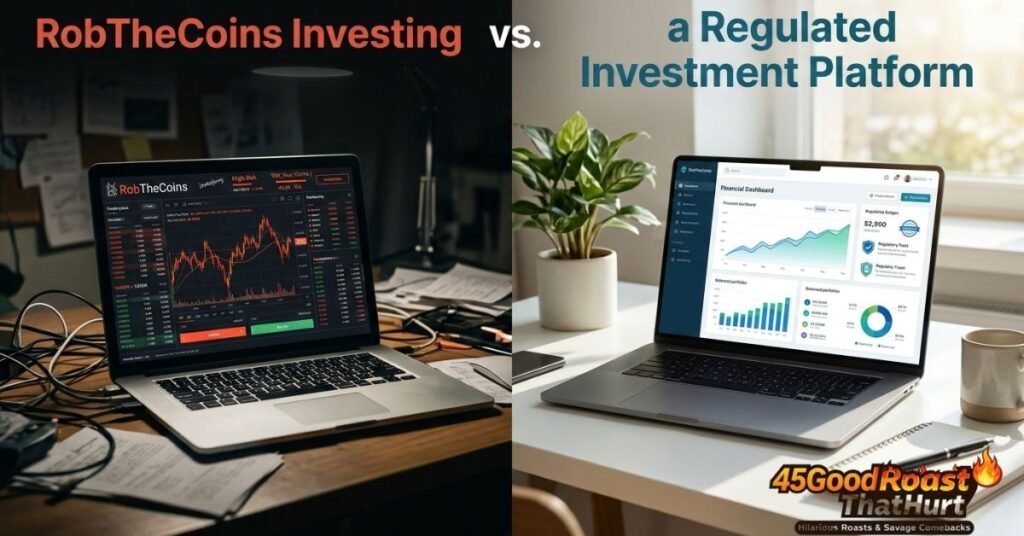
A regulated platform and an unverified one can look the same on the screen. The difference is what happens behind the scenes, especially when something goes wrong.
The table gives a quick comparison.
| Feature | Regulated Platform | Unverified Platform |
| Licensing | Listed with a regulator | No proof or unclear |
| Company details | Public and checkable | Hidden or vague |
| Customer funds | Rules for safekeeping | Often unclear |
| Complaints | Formal process exists | May have no process |
| Fees | Clearly listed | May change or be hidden |
Differences in Regulation and Accountability
Regulated firms must follow laws, submit reports, and answer to an authority. If they break rules, they can be fined or shut down.
An unverified site answers to no one in the same way. If a problem happens, you may have no place to complain. That is a big difference for ordinary savers.
Differences in Asset Custody and Investor Protection
Regulated brokers often keep client assets separate from company money. In some countries, there are also schemes that protect clients if a firm fails, though crypto often has less protection.
With an unknown platform, you must assume no protection at all. Even a regulated crypto firm may not cover every loss, so read the rules carefully.
Transparency, Fees, and Withdrawal Policies
Trusted platforms publish fees, terms, and withdrawal steps in plain view. You can read them before you register.
Unverified platforms may hide details or change them later. Always save a copy of the terms and fee list before you deposit.
RobTheCoins Investing Alternatives: Safer Ways to Invest Online
If your goal is to grow money or learn about crypto, you have safer paths. None of them is risk-free, but they are easier to check and often better protected.
Pick the option that fits your goals, time, and comfort with risk.
Regulated Online Investment Platforms
Many countries have licensed brokers and investment apps. They show their license details and follow rules about client money.
Look for clear fees, strong customer service, and a good record. Search the platform on your regulator’s list before you open an account.
Cryptocurrency Exchanges With Strong Security Measures
If you want crypto, choose a large exchange with a long history. Look for two-factor login, cold storage for most funds, and public security practices.
Check whether the exchange is registered where you live. Bigger does not mean risk-free, but it does mean more scrutiny.
Traditional Investing Through Regulated Brokers
Stocks, bonds, and funds are older and better regulated than crypto. Low-cost index funds are a common choice for long-term savers.
They can still lose value, but they are easier to understand and have more rules. Many beginners start here before looking at crypto.
How to Choose a Safer Investment Platform
Make a short checklist. Does it have a license you can verify? Does it show its owners and address? Are the fees clear? Can you withdraw easily?
Also test customer support with a simple question. If answers are slow, rude, or confusing, think twice.
Learning Directly From Regulators and Established Educators
Financial regulators often publish free guides on crypto risks and scams. Banks, universities, and consumer groups also share trusted lessons.
These sources have no reason to sell you anything. Use them to build a base before reading blogs with unclear goals.
Building a Habit of Slow, Verified Investing
Slow is safe. Set a monthly limit, write down your goals, and review once in a while. Avoid chasing hype.
Over time, patient habits protect you better than any “secret” strategy. A calm, boring plan often beats an exciting one.
Who Is RobTheCoins Investing Suitable For?
Because the nature of the brand is unclear, it is not a clear fit for most people. Still, some readers may find limited use in its general content, as long as they treat it carefully.
Here is a fair look at who might and might not benefit.
Potentially Useful for Readers Seeking General Information
A curious beginner may use these pages to pick up simple crypto words. Light reading can help you form questions to ask later.
Just remember that the content may be incomplete or copied. Use it as a doorway, not as a final answer.
Why It May Not Suit People Seeking Verified Investment Services
If you want a licensed place to hold or trade money, unverified information is not enough. You need proof of rules and protection.
People who cannot afford losses should be especially careful. When the details are unclear, a regulated option is a better match.
What It Cannot Substitute For
A blog cannot replace a licensed advisor, a regulated broker, or your own research. It also cannot replace a personal budget and emergency savings.
No website can know your income, debts, or goals. Only you and a qualified professional can build a plan for your situation.
How to Use RobTheCoins Content Responsibly
If you choose to read this type of content, use it wisely. A few simple habits will protect you from most problems.
Think of articles as conversation starters, not instructions.
Treat Educational Articles as a Starting Point
A first article should lead you to more questions. Write down new terms and look them up in trusted sources.
Never act on one article alone. If a page makes you feel rushed or excited, step away for a day.
Cross-Check Important Claims With Primary Sources
A primary source is the original place where information comes from. Examples include a regulator, a company filing, or a project’s official documents.
If a blog says a coin has a certain feature, check the project’s own pages. If it says a firm is licensed, check the regulator. Do not rely on repeating blogs.
Don’t Confuse Information With Financial Advice
General information is not personal advice. An article does not know your age, goals, or risk level.
Advice comes from a licensed professional who looks at your whole situation. Be wary of anyone who gives personal guidance without a license or a clear contract.
What to Check Before You Engage With RobTheCoins Material

Before you click, sign up, or share anything, do a quick safety scan. It takes only a few minutes and can save you a great deal of trouble.
Use the three checks below every time.
Website Transparency and Published Policies
Look for a privacy policy, terms of use, and a clear risk disclaimer. See whether the pages name a real business.
If these pages are missing, copied, or full of errors, take it as a warning. Honest sites tend to be open about how they work.
Accuracy of Financial and Cryptocurrency Claims
Check facts such as prices, dates, and rules in a second place. Watch for outdated numbers and exaggerated words.
If an article promises easy wealth, it is not accurate. Responsible writers explain risk as much as reward.
Security, Privacy, and External Links
Be careful with external links, pop-ups, and download buttons. Check that the site uses HTTPS, but remember that HTTPS alone does not prove honesty.
Avoid entering passwords or wallet phrases on any page you reached through a link you are unsure about. When in doubt, close the tab.
Common Investing Mistakes People Make With Online Platforms
Most losses come from simple mistakes, not complicated tricks. Knowing these mistakes in advance helps you avoid them.
Here are three of the most common.
Investing Without Independent Research
Many people trust a friend, an influencer, or a website and skip their own checks. Later, they find out the claims were false.
Always do your own homework. At the least, confirm who runs the platform, what you are buying, and how to get your money out.
Trusting Online Reviews Without Verification
Reviews can be bought, faked, or copied. A page with only glowing reviews is not proof of quality.
Mix many sources, including regulator warnings and independent forums. Pay attention to detailed stories, not just stars.
Risking More Money Than They Can Afford to Lose
Some people borrow money or use rent funds to invest. When the market falls, they face stress and bad choices.
Only invest what you can lose without harm to your life. Keep an emergency fund first, and treat crypto as high risk.
How Crypto Learning Differs From Traditional Investing
Learning about crypto is not the same as learning about stocks. The tools, rules, and risks vary. Seeing these differences makes you a smarter reader.
Understanding Digital Assets and Blockchain Networks
Digital assets live on blockchain networks and can be moved by anyone with the right keys. Many trade all day and all night, every day of the year.
Traditional assets trade on set hours through regulated exchanges. Crypto gives more freedom, but it also gives more responsibility to the user.
Comparing Risk, Accessibility, and Regulation
Crypto is easy to access but often more volatile. Rules differ widely by country and are still changing.
Traditional investing is usually slower and better regulated. Neither is perfect, but the safety nets are often stronger in the traditional world.
RobTheCoins Investing: Pros and Cons

A fair review should show both sides. Because facts are limited, this list is based on what the content appears to offer and what remains unknown.
| Possible Advantage | Possible Limitation |
| Simple language for beginners | Unclear ownership |
| Covers general crypto topics | No verified license found |
| Free to read | Many copied or inconsistent descriptions |
| May help you learn terms | Claims lack proof |
Potential Advantages of Its Educational Content
If the site focuses on teaching, its easy style may help new readers learn basic terms. Free information lowers the barrier to starting.
It may also spark good questions. Used with care, it could help you prepare for deeper study elsewhere.
Limitations and Uncertainties to Consider
The main limits are missing proof, mixed descriptions, and unclear ownership. There is no verified sign of a license or customer protection.
Since many sources repeat the same unproven claims, readers cannot rely on them. These gaps matter most if money is involved.
Basic Crypto and Investing Terms Worth Knowing
Learning a few words makes the whole topic less scary. Scammers often use big words to confuse you, so understanding the basics is a shield.
| Term | Simple Meaning |
| Blockchain | A shared digital record of transactions |
| Wallet | A tool that stores your crypto keys |
| Exchange | A marketplace to buy and sell crypto |
| Volatility | How fast prices go up and down |
| Liquidity | How easily you can sell an asset |
Blockchain, Cryptocurrency, and Digital Wallets
A blockchain is a record shared by many computers. A cryptocurrency is a digital coin that runs on one. A wallet holds the keys that prove you own your coins.
Keep your wallet keys private. Anyone who has them can move your coins, and there is no help desk to reverse it.
Exchange, Broker, and Custodian
An exchange matches buyers and sellers. A broker places trades for you. A custodian holds assets on your behalf.
Some companies do all three. Knowing which role a company plays helps you understand who is responsible for your money.
Volatility, Liquidity, and Risk Tolerance
Volatility is the size of price swings. Liquidity is how easily you can sell. Risk tolerance is how much loss you can handle without panic.
Your plan should match your own tolerance. If a drop of twenty percent would ruin your sleep, choose lower risk.
A Safer Path for Beginners: Looking at RobTheCoins Investing

If you are curious, you can still explore safely. The key is to slow down, check facts, and protect your money and data.
Follow these three habits.
Start With Financial Education
Begin with free lessons from regulators, banks, and schools. Learn about saving, budgeting, and risk first. Crypto can come later.
A strong base makes it much harder for a smooth talker to fool you. Education is the best protection you can build.
Verify Platforms Before Sharing Personal Information
Before you give your name, ID, or bank details, run through the ten checks above. Confirm the company, license, and fees.
If any answer is missing, do not share data. You can always return later when the answers are clear.
Build a Risk-Aware Investment Plan
Write down your goal, time frame, and the most you can lose. Spread your money so one mistake does not hurt too much.
Review the plan every few months. A written plan keeps your emotions from driving your choices.
Final Thoughts on RobTheCoins Investing
RobTheCoins is a name with many different descriptions and very little verified proof. We could not confirm an owner, a license, an official app, or a clear financial service. For that reason, we suggest treating it as an unverified name, not a trusted platform.
If you read its content, do so with care and check everything elsewhere. If you want to invest, choose licensed, transparent options, start small, and move slowly. Your money and your data are worth more than any quick promise.
Frequently Asked Questions
Is RobTheCoins a real company?
We could not confirm a registered company behind RobTheCoins. Check official business registries before you trust any claim.
Is RobTheCoins investing safe for beginners?
It cannot be called safe because key details are unverified. Beginners should avoid sending money until ownership, licenses, and fees are proven.
Is RobTheCoins regulated by any financial authority?
We found no proof of regulation. Search the regulator’s own website, not the logo on a page, to confirm any license.
What is RobTheCoins and how does it work?
Descriptions vary, but many pages call it a crypto education site. The exact model is unclear, so read the official terms yourself.
Does RobTheCoins have an official app?
We found no trustworthy proof of an official app. Check the publisher name in the official app store and avoid links from strangers.
How can I check if a crypto website is a scam?
Verify the company, license, fees, and withdrawal rules. Also search regulator warning lists and read independent complaints.
What are the biggest risks of investing in crypto?
The biggest risks are price swings, scams, lost keys, and weak platform rules. Only invest money you can afford to lose.
Can RobTheCoins guarantee profits?
No honest investment can guarantee profits. Any promise of guaranteed returns is a serious red flag.
What are safer alternatives to RobTheCoins investing?
Consider licensed brokers, large regulated exchanges, and low-cost funds. Always verify the license on the regulator’s website first.
What should I do if I already sent money to a suspicious site?
Stop sending money, save all records, and contact your bank and local financial regulator right away. Do not pay any “fees” to get funds back.

I’m Nova, a skilled AI content writer with 3 years of experience, specializing in heartfelt prayers, Bible messages, and uplifting spiritual content.