
Having the right lines to roast bullies is not about sinking to their level—it is about having sharp, confident words ready when someone tries to make you a target. A good comeback does not need cruelty. It needs calm, wit, and timing. That combination alone is enough to disarm most bullies completely.
Most people freeze when a bully strikes. Not because they are weak, but because they did not have the right words ready. That moment of silence feels like defeat, and bullies count on it. The good news is that confidence is something you can prepare for. The right line, delivered the right way, shifts the entire dynamic in seconds.
In this article, you will get 300+ lines to roast bullies organized by style, situation, and bully type — plus delivery tips, safety rules, and a guide on what not to say. Whether you are dealing with a school bully, an online troll, or a workplace aggressor, there is a comeback here for every moment.
What Makes a Good Line to Roast a Bully?
Before you pick a line, it helps to understand why some roasts work and others backfire. The best comebacks share three qualities: they are calm, they are specific to the behavior, and they are short enough to land before the moment passes.
Confidence Beats Aggression Every Time
Bullies want a reaction. Anger, tears, loud shouting — that is exactly what they are fishing for. When you respond with composed, sharp wit instead, you take away their power completely.
Compare these two responses:
- Aggressive reply: “Shut up; you’re such a jerk!” → gives the bully a reaction; escalates the situation
- Confident roast: “You talk a lot for someone with nothing to say.” → calm, cutting, and ends the exchange
The second version does not give them anything to work with. No emotion, no escalation — just a clean boundary delivered with confidence.
Target Behavior, Not Identity
The strongest roasts attack what someone does, not who they are. Roasting someone’s appearance, disability, family, or identity does not make you sharp — it makes you the bully. Keep it about their behavior, their obsession with attention, their need to feel superior.
- ❌ Wrong: Roasting their looks or personal life
- ✅ Right: “You’re putting in a lot of effort to seem unbothered.”
- ❌ Wrong: Anything involving their family
- ✅ Right: “Your need for an audience says more about you than anything I could say.”
- ❌ Wrong: Identity or disability attacks
- ✅ Right: “I’d argue with you, but I don’t debate hobbies.”
Smart vs Savage—Know the Difference
Smart roasts are composed, witty, and low-risk. They work in nearly any setting — school, work, online, or in public.
Savage roasts are sharper and hit harder. They are more satisfying in the moment but carry a higher risk of escalation. Use them only in situations where you are safe, and the exchange is verbal only.
| Smart Roast | Savage Roast |
| “Your opinion isn’t a requirement.” | “You’re the human version of a participation trophy.” |
| “I left my crayons at home.” | “Your ego’s writing checks your personality can’t cash.” |
| Lower risk, any setting | Higher punch, assess the situation first |
Quick Safety Rules Before You Roast
Roasting a bully can be effective — but only when it is safe to do so. Before you use any line in this article, run through these six rules.
- Never roast if you are outnumbered or if the bully is physically aggressive. Words work in verbal situations. If there is any physical threat, exit the situation and report it. No line is worth your safety.
- Never attack identity—no slurs, no appearance insults, no disability references. These cross a line you cannot uncross, and they will make you look worse than the bully.
- Roast their behavior, not who they are. Target the obsession with attention, the need to feel big, the pattern of aggression — not the person’s body or background.
- Keep it to one line, then exit. One sharp comeback is powerful. Going back and forth in a long exchange drains your energy and gives the bully more airtime. Say it once. Walk away.
- Online roasts should be shorter and drier. A five-word reply lands harder than a paragraph on social media. Trolls thrive on long responses.
- If it feels unsafe, walking away is the strongest move you can make. There is real confidence in choosing not to engage. Some situations do not need a comeback — they need distance.
These rules keep your line sharp — and keep you in control.
300+ Lines to Roast Bullies — The Ultimate List

Smart & Witty Roasts
When they will not stop talking:
- You talk a lot for someone with nothing to say.
- Your words are loud, but your points are invisible.
- I’d engage, but I don’t debate hobbies.
- You keep talking. I keep not caring. Funny how that works.
- Your commentary is running—unfortunately, so is my patience.
- You seem passionate about an opinion nobody asked for.
- You’re putting in a lot of effort to be ignored.
- Those were words. That was definitely words.
- I’ve heard more compelling arguments from dial tones.
- You speak as if facts are entirely optional.
When they try to embarrass you in front of others:
- Bold of you to perform for an audience that isn’t clapping.
- You tried. That’s the spirit.
- That was supposed to land, wasn’t it?
- Your need for an audience says more about you than I ever could.
- Keep going — this is educational.
- I’m watching you work so hard for so little.
- You’re really committed to this bit.
- The crowd is quiet. That should tell you something.
- You’re doing a lot to impress people who stopped watching.
- One more try. You’ll get there.
When they think they got you:
- Was that your best shot? I want to be fair.
- You swung. I’m still standing. What’s the next move?
- I’ve been more rattled by mild weather.
- Try that again with some preparation behind it.
- You look proud. That’s a little sad.
- I see what you were going for. It didn’t arrive.
- I’d be embarrassed for you, but that seems redundant.
- Your aim is as bad as your judgment.
- Almost. Keep practicing.
- That was genuinely not a threat.
When they’re obsessed with your reaction:
- You keep looking at me for a reaction I’m not going to give.
- I’m not performing for you today.
- You want emotion. I’m running low on that for you specifically.
- Your whole thing requires me to care. I don’t.
- Watching you watch me is the most interesting part of this.
- I’m not available for that reaction right now.
- Your plan only works if I participate. I’m out.
- You’re waiting on something that’s not coming.
- I exist on a different frequency than whatever you’re broadcasting.
- Not today. Probably not tomorrow either.
When they try to be clever:
- You almost had something there.
- That was a good setup. The landing needs work.
- Ah — sarcasm. The lowest form, but it suits you.
- I see you’ve been practicing. Keep going.
- That one had effort behind it. Admirable, honestly.
- Close. But you’re still losing.
- Points for creativity. Zero for execution.
- The idea was there. The follow-through? Less so.
- You’re getting warmer. Still cold, but warmer.
- A for effort. F for impact.
Savage Shut-Downs
For ego-driven bullies:
- Your ego is writing checks your personality can’t cash.
- Confidence is quiet. You’re just loud.
- You mistake volume for value.
- Your ego got here before you did and is already annoyed, everyone.
- You’re the most impressed person in the room with yourself.
- That level of self-belief would be inspiring if it had a basis.
- Real confidence doesn’t need an audience this badly.
- You’re bold. Unfortunately, bold and right are different things.
- You’d be unbearable if you were actually good at anything.
- Your self-image and your reputation had a meeting. It was tense.
When they escalate:
- You’re escalating a situation you started. Note that.
- Keep going. Every word is evidence.
- You’re really showing your entire hand right now.
- This is the version of you you want people to remember?
- This is going well for you.
- You’re working very hard to look very bad.
- The more you say, the less anyone believes you.
- You peaked at the opening insult. Downhill from there.
- You’re spiraling in real time. Respect for committing.
- You’ll regret at least four of those things.
For serious moments:
- I’m not going to match your energy. I have standards.
- Your approval has never been on my list of requirements.
- You don’t have the power to shake me that you think you have.
- What you say about me says nothing about me and everything about you.
- Keep going. I’ll still be fine when you stop.
- You came here for a reaction. I’m not running that program today.
- I don’t negotiate with behavior like that.
- You aimed for my confidence. You missed.
- I’ve heard worse from better people.
- You’re going to keep doing this until you realize it’s not working.
For the repeat offender:
- We’ve done this before. The result is going to be the same.
- Are you still here with this?
- I’ll save you the trouble—this ends the same way it always does.
- Consistency. Misplaced, but consistent.
- You’ve got one move, and it’s tired.
- This is starting to feel like a tribute act.
- You’re bringing yesterday’s energy to today’s situation.
- I’m not surprised. Just bored.
- Routine is comforting, I suppose.
- Same line. Same outcome. Different day.
Last-resort lines:
- We’re done here.
- That’s the last time I engage with this.
- I’m going to need you to stop.
- This conversation ended two exchanges ago.
- I don’t have this in me for you today.
- Walk away before this gets worse for you.
- No.
- Not doing this.
- You’ll figure out what just happened.
- Good luck with whatever this is.
Funny One-Liners
- I’d agree with you, but then we’d both be wrong.
- You bring joy to everyone—when you leave.
- I’d explain, but I left my crayons at home.
- Keep rolling your eyes—maybe you’ll find a brain back there.
- You’re the reason we have warning labels on things.
- I would roast you, but my momma said I’m not allowed to burn trash.
- You have your entire life to be an idiot. Take the day off.
- Your personality called—it wants a refund.
- You’re like a cloud. When you disappear, it’s a beautiful day.
- I’m not insulting you. I’m describing you.
- Somewhere out there, a tree is producing oxygen for you. Go apologize to it.
- You’re not stupid. You just have bad luck, thinking.
- If laughter is the best medicine, your face must be curing diseases.
- You have the right to remain silent. Please use it.
- I’d call you a tool, but that implies usefulness.
- You’re proof that evolution can go in reverse.
- Your face is fine; it’s your personality that needs the filter.
- You speak fluent nonsense.
- I was going to say something clever, but I see you’ve already embarrassed yourself.
- My patience for this has a speed limit. You’ve exceeded it.
- Is this a performance piece? Because the crowd is confused.
- You’re operating with a real confidence-to-competence imbalance there.
- I can explain it to you, but I can’t understand it for you.
- You’ve outdone yourself. That’s a low bar, but still.
- Respectfully — no.
- You tried. The results disagreed.
- Keep up the good work. This is excellent self-sabotage.
- At least you’re consistent at being wrong.
- I’d roast you harder, but I don’t want to start a fire with wet wood.
- I’ll need you to lower my expectations further before I can be disappointed.
- You’re a special kind of person. Not the kind anyone wants to be.
- You’ve got a face for podcasts.
- Bless your heart — truly.
- You made a full effort there. And it still didn’t work.
- I’m going to need a moment to process how much I don’t care.
- You’re the human equivalent of a Monday.
- I’ve seen better arguments from fortune cookies.
- That was brave. Misguided, but brave.
- Your reputation preceded you. Unfortunately.
- You should copyright that move — it’s uniquely bad.
- I’ve started ignoring you, and it’s going great, thank you.
- Somewhere, someone is missing you. Keep that in mind.
- You’re the type of person who brings a kazoo to a funeral.
- You’re unforgettable—and not in the way you’re hoping.
- I needed a laugh. Thanks for volunteering.
- It’s impressive how reliably you misread the room.
- You’re working very hard at a job nobody posted.
- Your social radar is out for maintenance, I see.
- You say that like it’s supposed to mean something.
- That was genuinely something. I’m going to need a minute.
Calm Confidence Roasts
- Your opinion isn’t a requirement.
- I don’t take directions from people I don’t respect.
- That’s not something I’m available for.
- I hear you. I’m just not moved by it.
- You’re allowed to feel that way. I’m allowed not to care.
- You seem very certain about a lot of things that aren’t your business.
- I’ve noted your feedback. Filed it under irrelevant.
- What you say and what matters are two different things today.
- I don’t owe you a reaction to that.
- I exist outside of your narrative.
- You said it as if it should land differently. It did not.
- I’m comfortable with myself, which seems to bother you.
- That is your interpretation. It’s not accurate, but it’s yours.
- Your words don’t define me. I do.
- I’ve heard that kind of thing before. I recovered.
- I’ll give you the silence that you deserve.
- You’re describing someone. I don’t think it’s me.
- I’m not going to argue about my own value with you.
- That’s a strong claim from someone I barely register.
- My day continues.
Sarcastic Burns
- Oh wow. That was devastating. I’ll need years of therapy.
- Congratulations. You found a way to be even less interesting.
- I’m writing that one down. Under “things that didn’t land.”
- Fascinating. Do go on. I’m taking notes on what not to do.
- You really committed to that one. The courage.
- That one had layers. All of them are hollow.
- I can see you put real thought into that. Shame.
- Incredible. That was almost an argument.
- Oh, good, more opinions. The world was running low.
- I appreciate you sharing. Truly. No, wait. I don’t.
- You said that like it was my problem.
- Sure. That makes sense. In a universe where nothing does.
- I see. And how long did that take to put together?
- You’re right. You absolutely should keep talking.
- That stung. Like a lukewarm breeze.
- Normally, that would bother me. Today is not normal.
- Thank you for your conversation service. It’s truly something.
- I’m marking this moment. As the one who didn’t matter.
- Wow. The depth. The nuance. The complete and total pointlessness.
- And yet nothing has changed.
Short Wordplay Zingers
- Noted. Ignored.
- That tracks, for you.
- Big energy. Small substance.
- Loud isn’t the same as right.
- Bye. Stay bye.
- Not my circus.
- Still standing, thanks.
- Try that one again with logic.
- That’s a yikes from me.
- Your move. I’m patient.
- Carry on. I’m not watching.
- Next?
- Hard pass.
- Not today. Try never.
- Keep going. I’m not listening.
- Interesting. Also no.
- You peaked just now. Downhill from here.
- I’ve survived worse. Significantly worse.
- That’s your problem.
- Bold. Also wrong.
Roasts for Every Situation

Lines to Roast Bullies at School
School situations call for short, clean lines that do not escalate and keep you out of trouble. A calm face and a one-liner land harder than anything loud or dramatic.
- This isn’t your stage. Go find one.
- You’re trying too hard for someone who’s losing.
- I don’t take notes from people who are failing the vibe check.
- That one was weak. I’d review and try again, but you’d still lose.
- You roast people because you can’t read the room. Work on that.
- Quiet confidence is a thing. You should look into it.
- My teacher pays more attention to me than you are getting right now. Go think about that.
- You picked the wrong person if you wanted a reaction.
- I’ve heard that joke. It was funnier the first time; it was bad.
- Sit down before you embarrass yourself further.
- You’re loud and wrong. That’s a rough combo.
- I’m focused on passing. You should try it.
- That’s not wit. That’s nonsense with grammar.
- Your social strategy needs a complete rewrite.
- Next time, bring something worth responding to.
Roasts for Online Bullies and Trolls
Online bullies want engagement above everything else. Short, dry, unbothered replies cut off their oxygen supply better than any long clap-back ever will.
- Okay.
- Not a threat.
- Still here. Still fine.
- You’re going to log off feeling worse about this.
- That was a lot of effort for zero impact.
- I see you. I’m not impressed.
- Your keyboard is working harder than your brain right now.
- Bold claims from an anonymous account.
- Screenshot this—it’s the moment nothing happened to me.
- You need an audience. I’m not it.
- I’ve blocked bigger accounts for less.
- You’re funnier when you’re not trying to be mean. Which is always.
- Your engagement is noted and immediately dismissed.
- The reply you wanted isn’t coming.
- You’re going to have to find someone else for this.
Roasts for Workplace Bullies
In a professional setting, your comeback needs to be firm, dignified, and completely HR-safe. Quiet authority works better here than a sharp burn.
- That comment wasn’t appropriate, and I’d like you to be aware of that.
- I’d prefer it if you kept that kind of remark out of our workspace.
- You and I work differently. This is not the approach I’d expect.
- I’m not going to respond to that the way you’re hoping I will.
- You seem very confident about something that isn’t your area.
- I’ll let that one go. Once.
- That’s not professional, and I think you know that.
- I’ve noted what was said here. Moving on.
- I’m not interested in this dynamic. Let’s keep things professional.
- You’re better than this. Or at least you should be by now.
- My performance speaks for itself. Your opinion doesn’t change it.
- I’d appreciate it if we kept our interactions constructive.
- That’s not something I’m willing to let slide.
- I’ll pretend that didn’t happen—this time.
- My work is solid. Whatever you’re doing here isn’t.
Lines for Group Settings
When a bully has an audience, they are performing — and one calm, witty line in front of that audience flips the entire dynamic instantly.
- Do that again in front of people who respect you. Oh wait.
- Your audience is quiet. That’s not applause.
- You’re doing this in front of people. Note how it’s going.
- Say it louder so everyone can hear how this plays out for you.
- You thought this would land differently with a crowd. Interesting.
- Everyone watching you right now is uncomfortable. Except me.
- You’re performing for an audience that stopped clapping.
- The room just watched you lose. They’re polite not to say it.
- Keep going — you’re giving everyone here a story.
- Bold move. The group scorecard is not in your favor.
Roasts by Type of Bully
No two bullies are the same. The most effective roast targets the specific motivation behind the behavior, which means knowing which type you are dealing with.
The Ego-Driven Bully
This bully needs to feel superior at all times. Their self-worth depends on putting others down. The best roasts expose their insecurity without matching their aggression.
- Your ego showed up before you did and already made things awkward.
- Confidence is earned. Whatever this is has a different name.
- You need people smaller than you just to feel average. Think about that.
- Your opinion of yourself is the most creative fiction I’ve encountered.
- The gap between your self-image and reality is something to see.
- You confuse loudness with leadership. Classic.
- Real strength doesn’t need someone to kneel for it to exist.
- You’re the most impressed person in the room—about yourself.
- That’s a lot of identity to protect for someone who can’t take a calm reply.
- You should meet yourself from the outside. It’s a humbling experience.
The Insecure Attention-Seeker
This bully needs to be noticed. They use mockery as a strategy to become the center of the room. The best roasts calmly expose the desperation behind the performance.
- You need a reaction this badly? That’s the saddest thing here.
- The louder you get, the less anyone listens. You should know that by now.
- You’re not confident — you’re just scared of silence.
- Your need for this much attention is something to look into.
- You’re performing for a crowd that’s now just watching with concern.
- I genuinely hope you get what you’re looking for from this. You won’t. But I hope.
- If you wanted to be noticed, there are better methods.
- You’re mistaking reaction for connection. They’re not the same thing.
- The energy you’re spending here is going to exhaust you before it impresses anyone.
- This is a lot of noise from someone with nothing underneath it.
The Group Bully—When They Have Backup
This bully uses an audience to amplify their power. The key is to address the behavior publicly, briefly, and without engaging the crowd directly.
Note: If you are alone, outnumbered, and the situation feels physically unsafe—exit first. No comeback is worth your safety.
- You brought a crowd because you can’t do this alone. That’s the whole story.
- The backup is noted. Still not rattled.
- You need that many people just to feel big? Think about that tonight.
- All those people watching, and you’re still the smallest one here.
- The crowd doesn’t make your point stronger. Just noisier.
- You travel in groups because you don’t have enough on your own. Understandable.
- Your whole strategy depends on an audience. What happens when they leave?
- I’m not performing for your group. You can let them know.
- None of these people is going to remember this the way you think they will.
- You needed all of this just to talk to me. I’m flattered.
The Online Keyboard Warrior
Bold online. Quiet in person. The online bully thrives on engagement and emotional responses. The best counter is a calm, brief reply that denies them both.
- Your username says everything.
- You type with real confidence for someone who logs off eventually.
- This is your contribution today. Okay.
- I’ve read this. I’ve felt nothing. Moving on.
- Your bravery is truly something. From here.
- You’re angrier about my existence than I am. That says a lot.
- This comment will be here long after you forget you made it.
- You came here for a fight. You’re getting a calm reply. Adjust.
- You’ll be different in person. They all are.
- You typed all of that. And for what?
How to Deliver Your Roast Perfectly
Having the line is half the work. How you say it determines everything.
The 3-Second Rule
The ideal delivery window for a comeback is within three seconds of the bully’s line. Wait longer than that, and the moment passes—the comeback reads as rehearsed or defensive instead of natural and confident.
You do not need to rush. Three seconds feels natural in conversation. It signals that you were not shaken, that you did not need to think hard, and that the bully’s words genuinely did not reach you.
- Within 3 seconds: “Okay, and?” — reads as unbothered, sharp, in control
- After 10 seconds: “Okay, and?” — reads as a delayed recovery
If you genuinely need a beat, a slow breath, and a steady look buys you those three seconds without looking rattled. Composure is the point — not speed.
Body Language + Tone
Your delivery is doing 60% of the work. A great line with nervous body language loses half its power.
- Posture: Stand or sit straight. Do not shrink, cross your arms defensively, or turn away first.
- Eye contact: Hold it through the line. Break it when you choose to — not in response to them.
- Voice level: Keep it flat and even. No yelling, no trembling. Calm volume lands harder than shouting.
- Facial expression: Neutral or mildly amused. Not angry, not scared, not smiling too hard. The line carries the weight—let it.
Say It Once — Then Exit
One line is enough. Do not explain it. Do not repeat it. Do not wait to see how they react.
The moment you start explaining your comeback, you have already softened it. The exit after the line is part of the line. Delivering the roast and walking away is not running — it is the final move. It says: I made my point. There is nothing left to say.
The Exit Strategy
What you do in the sixty seconds after the roast matters as much as the roast itself.
- Do not linger. Leave the scene or shift your attention immediately to your phone, your work, or another person.
- Do not look back. Looking back for a reaction undoes the power of the exit. The whole point is that their response no longer concerns you.
- Do not replay it loudly. If you are with friends, do not immediately rehash the comeback for their approval. It reads as insecurity and keeps you anchored to the moment.
- Do not bring it up again yourself. Let it be finished. If they bring it up later, a calm “I’m not re-opening that” is enough.
The Psychology of Bullying: Why These Lines Actually Work
Understanding why roasts work makes you better at using them — and better at knowing when not to.
Bullies Are Wired to Need a Reaction
Bullying is a control behavior. It is designed to provoke a response — anger, embarrassment, tears — because that response confirms the bully’s power over the target.
When you respond with calm wit instead of emotion, you break the loop entirely. The bully did not get what they came for. The behavior that usually produces a result suddenly produced nothing. That disruption is psychologically destabilizing for someone whose whole strategy depends on the reaction arriving on schedule.
How Confidence Disrupts the Bully Pattern
A smart roast delivered without visible emotion sends a very specific message: this does not reach me. That message matters because bullying requires a target who is movable. If your confidence signals clearly that you are not movable, the bully has no operating space.
This is why delivery matters as much as the words. A line said with shakiness feeds the bully just enough to keep going. The same line said with full calm composure communicates that intimidation simply will not work here, and most bullies will take that signal and redirect.
Roasts to Avoid: Lines That Backfire
Not all roasts are equal. These six types of comebacks tend to make the situation worse, not better.
- Appearance attacks. Roasting someone’s body, face, weight, or clothes immediately makes you the aggressor. It escalates the situation and gives the bully a new narrative where you are the problem.
- Family references. Bringing in someone’s parents, siblings, or home life is a hard line. It is almost always perceived as a serious escalation, not a clever comeback.
- Long monologues. Spending thirty seconds on a comeback is not power — it is desperation with better words. Bullies (and the audience) read long responses as evidence that the original attack landed hard. Keep it short.
- Profanity in school or work settings. Swearing puts you at risk of consequences that have nothing to do with the bully. It shifts attention from their behavior to yours.
- Identity-based insults. Any line targeting race, religion, gender, sexuality, disability, or background is off-limits. No exceptions. These lines reveal more about you than they do about the bully.
- Anything you would be embarrassed to repeat to a teacher or manager. If you would not say it in front of an authority figure, it is not the right line for this situation.
The goal is control, not cruelty—and these types of lines hand control right back to the bully.
What to Do If the Bully Escalates
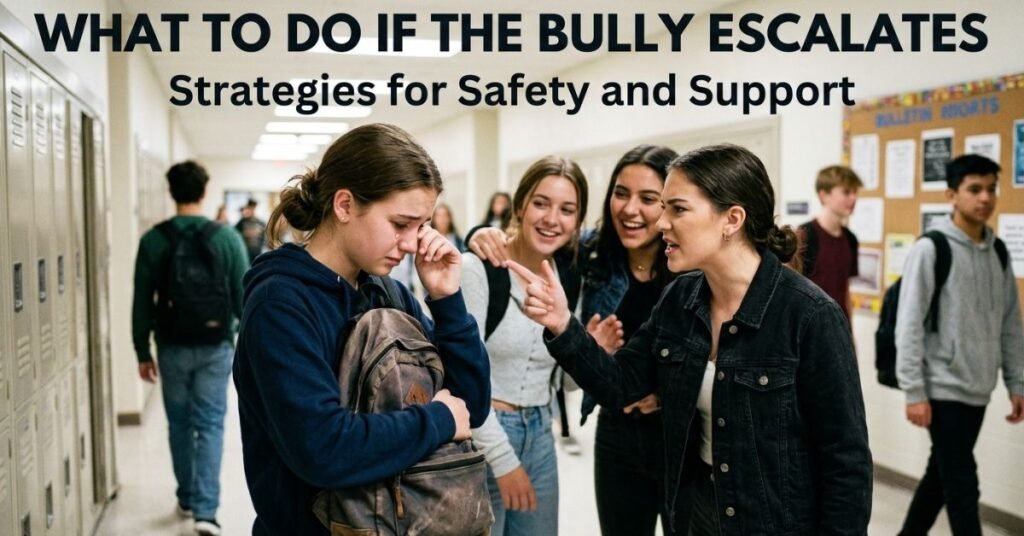
Roasts work in most verbal situations. But some bullying crosses lines that words cannot solve.
When to Stop Roasting and Report
If bullying becomes a pattern — repeated targeting over days or weeks — a clever comeback is no longer the right tool. If a bully begins making physical threats, involving groups, or targeting you online with a sustained campaign, that requires reporting to an adult, a teacher, HR, or another authority, depending on your setting.
Reporting is not a weakness. It is recognizing when a situation has grown past what verbal self-defense can handle—and choosing the response that actually addresses the root problem.
Protecting Your Mental Health After Bullying
Being consistently targeted takes a real toll on your confidence and emotional well-being — even when you handle it well on the outside. Talking to someone you trust — a friend, a counselor, a parent, or a mentor — is not optional care. It is necessary care.
You do not need to process it alone. The strongest thing you can do after standing up for yourself verbally is to make sure you are also taking care of the person doing the standing.
Conclusion
You now have 300+ lines to roast bullies — organized by style, situation, and bully type — plus delivery tips, safety rules, and the psychology behind why these lines actually work. More importantly, you have the framework to use them well: calmly, briefly, and with the full confidence that you are not doing this to be cruel — you are doing it to make clear that disrespect will not land the way the bully expects it to.
A great roast is not about winning a fight. It is about sending a quiet, unmistakable signal: this does not move me. That signal, delivered right, ends most situations before they can grow.
Bookmark this page. The next time a bully opens their mouth, you will be ready.
FAQs
Q: What is the best line to say to a bully to shut them down instantly?
Short and calm always wins. “You talk a lot for someone with nothing to say,” or a flat “Noted. Ignored” hit harder than anything long or emotional. The line should be delivered with a straight face and followed immediately by disengagement.
Q: Are these roasts safe to use at school?
Most of the lines in the Smart, Funny, and Calm Confidence sections are school-appropriate. Avoid the Savage section in school settings—those carry a higher escalation risk. Always exit the exchange after one line and do not continue back-and-forth in front of a group.
Q: What should I do if a bully escalates after I roast them?
Stop engaging verbally and create physical distance. If the escalation involves threats or repeated targeting, report it to a teacher, counselor, or administrator. No comeback is worth putting yourself in physical danger.
Q: Is it better to roast a bully or ignore them?
It depends on the situation. Ignoring is often the smartest move, especially online. A roast works well when the bully is seeking a reaction, and a calm, witty response can shift the dynamic. If ignoring consistently de-escalates the situation, that is always the lower-risk choice.
Q: How do I deliver a roast without looking nervous?
Breathe before you speak, lower your voice slightly, and hold eye contact through the line. Practice short lines out loud before you need them — the familiarity of the words removes the hesitation from your delivery.
Q: What type of roast works best for an online bully?
Short, dry, and unemotional. A five-word reply outperforms a paragraph every time. Online bullies want engagement and emotional spillover — denying them both is the most effective response available to you.

I’m Nova, a skilled AI content writer with 3 years of experience, specializing in heartfelt prayers, Bible messages, and uplifting spiritual content.